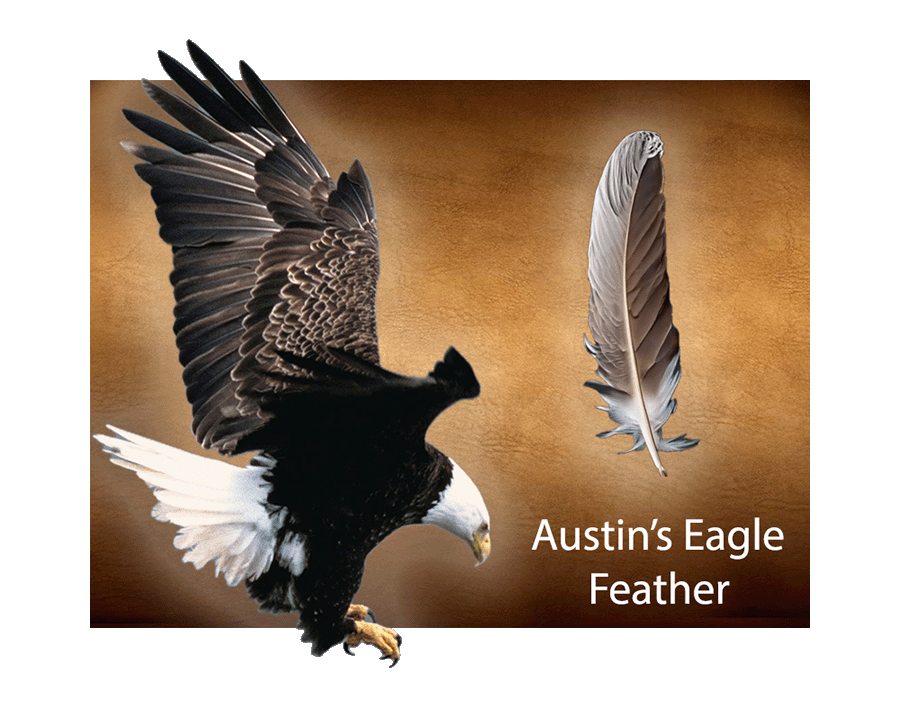
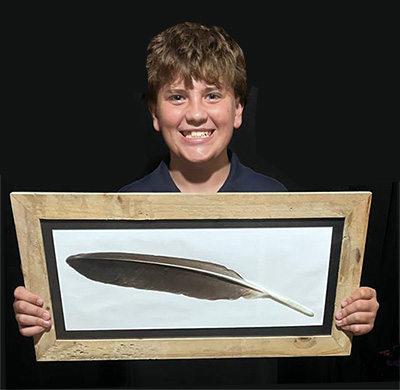
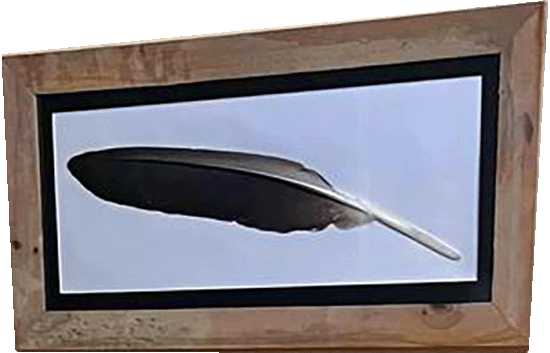
| My Dear Austin, My mother, Virginia Phillips, “Kaajisnaak”, gave me this Eagle Feather. You are to protect it and pass it down to your son or daughter when the time comes. Love, Neena & Grandfather
Moiety: Raven or Eagle Clans: Raven, Dogsalmon, Coho, Frog, Eagle, Bear, Wolf, Killer Whale
There are many more clans. . The Raven is the smartest of all birds and the Dogsalmon is the smartest of all fish. The correct way to introduce my self is to give my name, then say I am Tlinget, Raven, Dog Salmon and adopted by a Frog and the child of an Eagle. Included in the introduction are the names of my parents, and grandparents as far back as possible and the name of the person who adopted me. Children always are under the Tribe, Moiety, and Clan of the mother.
Thus all my children are Raven, Dogsalmon and so are the children of my daughters.
Did you know that a mother passes on her mya? I am Tlinget, Raven and a Dogsalmon. I am a child of an Eagle Redus Homer Cameron who was white and adopted by Jessie Walton Price The rest of you are Eagles and do the same introduction only reverse who you are and a child of.
Gúdaa níḵwch / Ax̲ ’yei yoo x̲ atángi
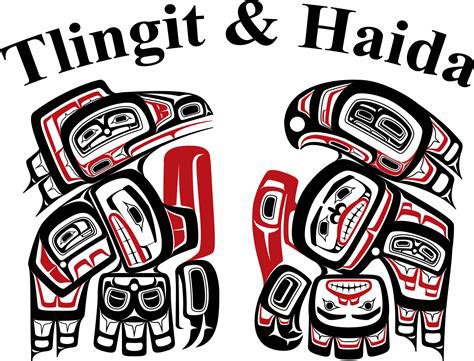
Certificate of Eagle Feather Inheritance Haa Aaní káa yéi kkg̱ wajée – On Our Land This Will Be Yéil Koowdzitee – The Eagle Has Been Given
This bald eagle tail feather (ch’áak’ koowdzitee) is presented on this day,
December 25, 2025 This feather was carried by my hands and heart before me, and by the hands of our ancestors before them.
It has flown at potlatches, cried at memorials,
and carried our prayers to the highest sky
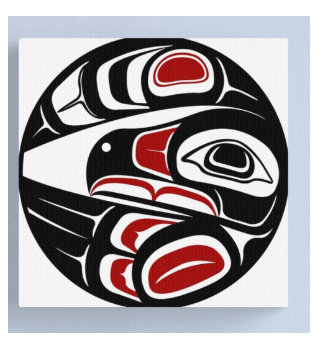 New Name As is my Right and Privilege to do so - Austin Phillips I name you Yéil Tláx ̱ wi. December 11, 2025 The name/phrase “Raven Mist” as a proper name or poetic title can be translated into Tlingit (Lingít) in a natural and culturally appropriate way. Tlingit traditionally names things descriptively, so we combine the words for “raven” and “mist/fog” into a compound-like phrase. Here are the most accurate and commonly accepted ways to say “Raven Mist” in Tlingit: Natural descriptivename (most common style for a title, place, or person):
Yéil Tláx̱w Yéil = Raven (the culture hero and trickster) Slightly more possessive/literal version (“Mist of Raven” or “Raven’s Mist”): Yéil Tláx̱wi The ending -i makes it “Raven’s mist” or “mist belonging to Raven”. Pronunciation: yale t’lahkhwee
If you want it to sound like a formal Tlingit personal or clan-style name:
Yéil Tláx̱w Hít (“Raven Mist House”) or Yéil Tláx̱w Tlein (“Great Raven Mist”) are
sometimes used for dramatic names, but the simple Yéil Tláx̱w is the cleanest
and most authentic. |

| EAGLE FEATHERS | |
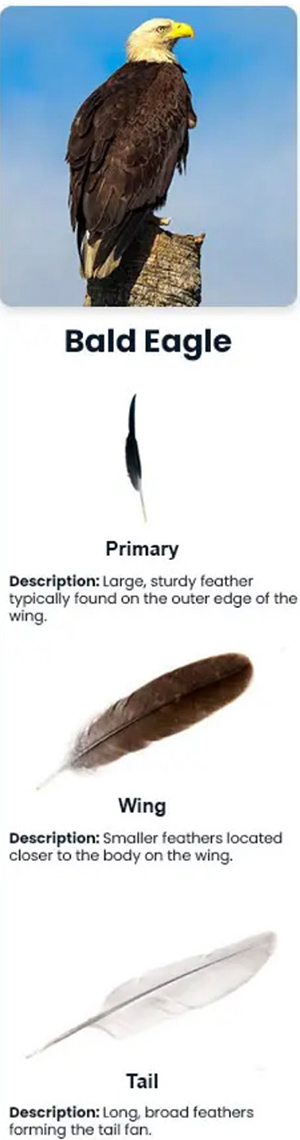 |
Every eagle has different types of feathers located at the tip of its wind. These feathers are not for show-offs but help them fly high and carry out their tasks efficiently.
Firstly, the primary feathers are placed on the overall body of the eagle. Primary/contour feathers are the steering wheel, which lets the eagle fly high. They allow them to change directions and control speed and altitude. Secondly, the secondary feathers are placed just beneath the primary feathers. They also allow them to dive, glide, or make sharp turns easily by just adjusting their feathers. They are also called flight feathers. Eagles use their tail feathers to communicate and convey signals. They often spread out their tail feathers to signal other birds of their strength and dominance. Down feathers are located under the primary feathers. They are fluffy and soft and provide warmth and insulation to eagles in top locations. Covert feathers are the small feathers that help the body of an eagle to streamline their flight.
|
Who May Legally Possess Them (2025)
Special Notes for Enrolled Tlingit and Other Federally Recognized Tribal Members
General Rule for Non-Native People
It is illegal for anyone who is not an enrolled member of a federally recognized tribe to possess bald or golden eagle feathers or parts without a federal permit.
Relevant laws:
• Bald and Golden Eagle Protection Act (16 U.S.C. § 668–668d)
• Migratory Bird Treaty Act (16 U.S.C. § 703–712)
Penalties: Up to $100,000 fine and/or jail time.
Exception for Enrolled Members of Federally Recognized Tribes (Including Tlingit)
As an enrolled Tlingit (or any enrolled member of a federally recognized tribe/Alaska Native village), you may legally:
• Possess eagle feathers and parts
• Use them in ceremonies, regalia, powwows, funerals, etc.
• Pass them down to family or other tribal members
No personal permit is required for simple possession and cultural/religious use.
Legal Ways to Obtain Eagle Feathers Today
• National Eagle Repository (U.S. Fish & Wildlife Service) – the only nationwide legal source
– Free feathers/parts (you pay return shipping only)
– Application: Form 3-200-15a
– Website: https://www.fws.gov/eaglerepository
– Wait time: 6 months to 3+ years
– Required proof: Tribal enrollment card, CDIB, or letter from tribe
• Some tribes and Alaska Native villages have limited salvage permits for eagles found dead on
tribal lands.
What Is Still Illegal (Even for Native People)
• Buying or selling eagle feathers or parts (felony, except certain pre-1940 antique items)
• Picking up feathers found in the wild (unless your tribe has an authorized salvage permit)
• Possessing feathers from non-eagle migratory birds (hawks, owls, ravens, etc.) without
separate permits
Quick Reference for Enrolled Tlingit Members
✓ You may own, wear, and inherit eagle feathers
✓ Obtain new feathers only from the National Eagle Repository or authorized tribal sources
✓ Never buy or sell them
✓ Carry your tribal enrollment card when traveling with regalia
✓Emergency/loaner feathers: Contact your tribe, Sealaska Heritage Institute, or regional Alaska
Native nonprofit